

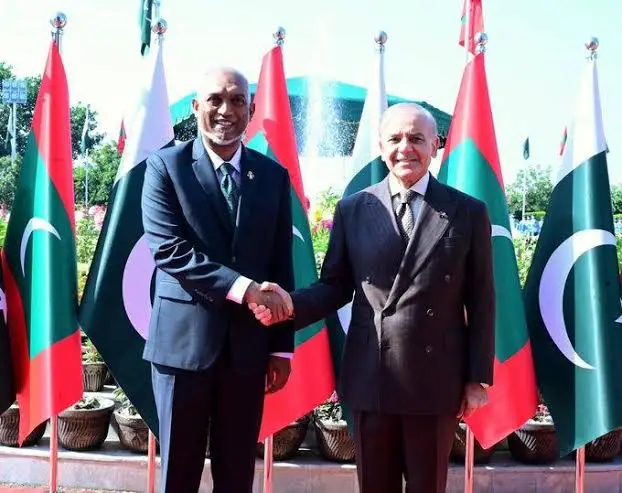
International diplomacy has always been a theater of grand gestures, but the recent state visit of Maldivian President Mohamed Muizzu to Islamabad takes the performance to a new level. Marking the first such visit by a Maldivian head of state in over a decade, the summit culminated in the signing of an astonishing 20 agreements and a joint declaration to skyrocket bilateral trade. To the casual observer, it looks like the dawning of a powerful new South Asian alliance. To the realist, however, it is a masterclass in political optics, built on economic foundations so thin they border on the mythical.
The centerpiece of this newly minted partnership is a pledge to expand bilateral trade from a meager $13.9 million to a staggering $200 million within the next two years. On paper, a 15-fold trade explosion makes for an electrifying headline. In the unforgiving world of logistics and economics, it is a statistical fantasy.
Trade does not materialize simply because two leaders shake hands in front of a camera flash. It requires infrastructure, institutional trust, and market demand. Currently, there are no direct commercial flights connecting Pakistan and the Maldives. There are no established, cost-effective maritime cargo lanes. To move a shipping container between Islamabad and Malé requires complex, multi-port routing that makes the cost of commerce prohibitively expensive. Expecting private businesses to suddenly switch supply chains and absorb these logistical premium costs to hit an arbitrary multi-million-dollar political target in 24 months is entirely divorced from commercial reality.
Beyond the ledger books, the alliance faces a deeper, structural credibility problem. President Muizzu is attempting to anchor a key diplomatic partnership to a nation grappling with profound domestic volatility. Pakistan remains deeply mired in institutional instability, severe financial crises, and ongoing internal security challenges that have long damaged its international reputation and strained its ties with global financial bodies. For an island economy like the Maldives, which relies heavily on international tourism, high-end foreign investment, and an image of pristine stability, aligning too closely with a state perceived globally as volatile and security-compromised is a massive liabilities risk.
The geopolitical rhetoric coming out of the summit leans even heavier into pure theater. President Muizzu used his platform in Islamabad to call for a revival of the South Asian Association for Regional Cooperation (SAARC). It is a noble sentiment, but one that ignores the elephant in the room. SAARC has been effectively comatose since 2016, paralyzed entirely by the deep-seated, intractable rivalry between India and Pakistan—a gridlock exacerbated by long-standing regional disputes over cross-border security. The idea that a diplomatic push from Malé can suddenly thaw decades of hostility and breathe life back into SAARC is not just optimistic; it is performance art.
Why, then, go through the motions of signing 20 separate memoranda of understanding if the underlying math and mechanics do not add up? Because in modern statecraft, the optics are the currency.
For President Muizzu, this high-profile embrace of Islamabad is less about forging a genuine economic lifeline and more about sending a pointed message to New Delhi. Since taking office on a platform of diversifying the Maldives’ foreign dependencies, Muizzu has used external alignments as a tool for domestic and regional leverage. Standing shoulder-to-shoulder with Pakistan’s leadership signals absolute strategic autonomy. It is a visual demonstration to India that the Maldives refuses to be confined to anyone’s traditional sphere of influence. The louder the optics in Islamabad, the greater the Maldives’ bargaining chips when negotiating future aid, debt restructuring, or infrastructure loans with either New Delhi or Beijing.
For Pakistan, the benefits are equally symbolic. At a time when Islamabad faces severe domestic economic strain and complex foreign policy hurdles, playing host to an international state visit provides a welcome domestic distraction. It projects the image of a nation that remains a pivotal, active player in regional affairs, capable of expanding its diplomatic and maritime footprints into the vital corridors of the Indian Ocean despite its international isolation.
We must learn to separate the ink on the treaties from the reality on the ground. A modest increase in functional cooperation—such as small-scale pharmaceutical imports or localized military training—is entirely feasible. But the sweeping narrative of a massive economic and institutional pivot between Islamabad and Malé is an illusion.
The Islamabad-Malé accords are not a blueprint for a new economic bloc. They are a carefully choreographed piece of political theater where both actors got exactly what they wanted: a loud, public-relations victory that costs very little, changes even less on the ground, and leaves the difficult reality of actually building a stable alliance for another day.